This guide is based on my personal experience as a MEXT scholar and graduate student in Japan — see the Awards section of my CV for the scholarships I received. I hope it helps you on your journey.
Jump to: About Scholarships · Studying Abroad · Graduate Studies in Japan · After Arriving in Japan
About Scholarships
What is a scholarship or financial assistance program?
A scholarship is a sum of money awarded to a student by an educational organization to help cover the cost of their education. The funds are paid by the institution or a sponsoring organization — and unlike a loan, a scholarship does not need to be repaid.
What does a scholarship cover?
Most programs cover tuition and fees only. Some scholarships also provide:
- A fixed monthly living allowance (baon)
- Book allowance
- Transportation allowance (issued each semester, every 6 months)
What kinds of scholarships exist in the Philippines?
| Type | Description |
|---|---|
| Merit-based | Awarded based on academic, artistic, athletic, or other achievements. Extracurricular activities and community service are often considered. Most are paid directly to the institution the student attends. |
| Need-based | Awarded based on the financial situation of the student and their family. |
| Student-specific | Open only to applicants who meet certain criteria such as gender, race, religion, or family background. Minority scholarships are the most common example; others include scholarships for children of faculty members or military personnel. |
| Career-specific | Awarded to students who plan to pursue a particular field of study. The most generous awards tend to go toward high-need areas such as education or nursing. |
| College-specific | Offered by individual colleges and universities to highly qualified applicants on the basis of academic and personal achievement. These may result in a full scholarship or a reduced tuition rate. |
About Studying Abroad
Should I consider studying abroad?
Absolutely. Studying abroad is one of the best decisions I have ever made. During those formative years, I experienced great joy in discovering new people, places, and perspectives.
Studying abroad opens your eyes to possibilities that are difficult to find when you stay within the familiar — your home country, your usual circle of friends. Living outside your comfort zone teaches you a great deal about yourself, other people, and the world.
It is a significant undertaking that requires preparation: physical, mental, and financial. I was fortunate that the MEXT scholarship took care of the financial side. At the same time, you should expect periods of difficulty — isolation is real, and you will miss the people you love. Prepare for that honestly. In the end, though, the benefits of this experience far outweigh the challenges.
How do I apply to study abroad?
Start by identifying a university that fits your needs: a strong academic or research program in your field, a supportive environment, and available scholarship funding.
The sections below focus on my personal experience applying to Japanese universities and navigating their scholarship system.
About Graduate Studies in Japan
How do I apply to a Japanese university?
The Japanese higher education system differs significantly from the Western model. As a prospective graduate student, you must first contact a professor directly to inquire about a graduate or research position in their laboratory. Only after the professor provisionally agrees to supervise you will the admissions office allow you to submit a formal application.
Scholarships such as MEXT are typically coupled with the admission application. You may also apply as a self-funded (privately-financed) student. The general process is:
- Mail your application documents to the graduate admissions office by the deadline (forms are usually available on the university’s website)
- Attend an online interview, and possibly an online entrance exam
- If you pass, you will first receive notification by email, followed by an official acceptance letter sent to your home address — including detailed instructions on how to apply for a visa, book a flight, and prepare for arrival
Can I see sample application documents for a Japanese university?
Here are the documents I submitted to:
- Tohoku University (2013)
- The Graduate University of Advanced Studies (Sokendai, 2015)
- The University of Tokyo (2015)
(Documents coming soon — email me if you need them urgently.)
What is the MEXT Scholarship?
MEXT (Ministry of Education, Culture, Sports, Science and Technology) is the Japanese government agency that offers scholarships, grants, and bursaries to international students who wish to study or conduct research in Japan.
There are six scholarship categories:
- Undergraduate
- Teacher Training
- Specialized Training
- College of Technology
- Japanese Studies
- Research Student (post-graduate) ← this is the category I applied for
I can only speak from experience about the Research category, which has two application routes:
- Direct University Application
- Japanese Embassy Recommendation
How do I apply for the MEXT Scholarship?
Via Direct University Application
This route is for prospective master’s or PhD students.
- Contact a Japanese university directly and apply to one of their graduate programs
- Mail your application documents to the graduate admissions office before the deadline (forms are usually downloadable from the university’s website)
- The MEXT scholarship application is included as part of the admission process — often it is simply a checkbox indicating that you wish to be considered for the scholarship
My experience: I applied to Tohoku University’s IGPAS (International Graduate Program for Advanced Studies) in October 2013. After passing a three-day physics and mathematics exam and a two-day physics essay exam, I was invited for an online interview in November. The interview with my prospective adviser lasted about 10 to 15 minutes via Skype.
Results were released in mid-January. I was admitted but did not receive the scholarship. This meant I could have enrolled as a self-funded student and applied for other scholarships after arriving, or sought sponsorship from a Philippine government agency.
One likely reason I was not awarded the MEXT scholarship was that I was below their minimum age requirement of 22 (exceptions are made only in rare cases).
Rather than enrolling without funding, I chose to withdraw from Tohoku University and pursue a scholarship before committing to a program in Japan.
Via Embassy Recommendation
This route is for prospective master’s or PhD students who want to spend an initial period in Japan doing research or language training before enrolling in a degree program.
Before you apply: Make sure you can complete any pending obligations — such as a return-service agreement with an employer or institution — before April of your intended intake year.
Eligibility (2027 intake):
- Born on or after April 2, 1992 (maximum age ~34 at time of intake)
- University or college graduate
- Must intend to continue a field of study previously begun — switching to an entirely new field is not permitted
- After passing the first selection, you must obtain a Letter of Provisional Acceptance from a Japanese professor willing to supervise your research
Steps:
- Review the MEXT scholarship rules and eligibility requirements in the official application guide, available on the MEXT website
- Research potential professors and universities in your field in advance, but note that direct contact with professors is only permitted after passing the first selection
- If you meet the eligibility requirements, obtain application forms from the Philippine Embassy (forms are typically made available in February or March)
- Keep in mind that the entire process takes approximately one year — it is best to begin applying during your final year of undergraduate study
Required documents:
| Document | Notes |
|---|---|
| Agreement on Document Submission | Required; omitting it will negatively affect your application |
| Certificate of Health | Must use the prescribed form; doctor must include full name, institution address, and preferably a wet signature |
| Certificate of English Language Proficiency | TOEIC, TOEFL, IELTS, or a “medium of instruction” certificate issued by your most recently attended school |
| Certificate of Japanese Language Proficiency | Optional; accepted tests include JLPT, JFT-Basic, and Japanese NAT-TEST. Course completion certificates are not accepted |
| Recommendation Letter | Wet signature preferred; if not possible, an e-signature with the request email trail is acceptable, as is a notarized copy |
All submitted documents will not be returned. Make copies of everything before submission.
Which route is better: University or Embassy?
It depends on your situation. The two programs differ in important ways, and their application periods do not overlap, so it is possible to apply to both — which is what I did.
| Via University Recommendation | Via Embassy Recommendation | |
|---|---|---|
| Eligibility | For graduate programs (also applicable for special undergraduate programs) | For a combined language and research program, with the possibility of advancing to a graduate degree; also applicable for undergraduate programs |
| Language Program | No separate Japanese language program — you begin your master’s or PhD program immediately | Includes a 6-month Japanese language program before the start of your research program; this may be held at a different institution (e.g., 6 months at TUFS, then transfer to Sokendai for research) |
| Application Procedure | Typically requires an online exam and interview; comparatively easier to pass | Follows the general application procedure of most universities, including a written exam and interview |
| Application Period | Varies by university; typically 6 months from application to acceptance | Varies by embassy; usually April–May, with approximately 1 year from application to acceptance |
| Acceptance Quota | A fixed quota applies to the number of students granted a scholarship (e.g., 18 international students per university) | No fixed quota on the number of scholars set by the Japanese Embassy in the Philippines (24 students were accepted in 2015) |
| Period of Scholarship | 2 years for a master’s degree, extendable to 3 years for a PhD | 18 or 24 months for research studentship, extendable to 2 years for a master’s degree and 3 years for a PhD |
| Notes | — | During the research studentship or language training period, you must apply to a Japanese university if you wish to advance to a master’s program (required within 24 months) |
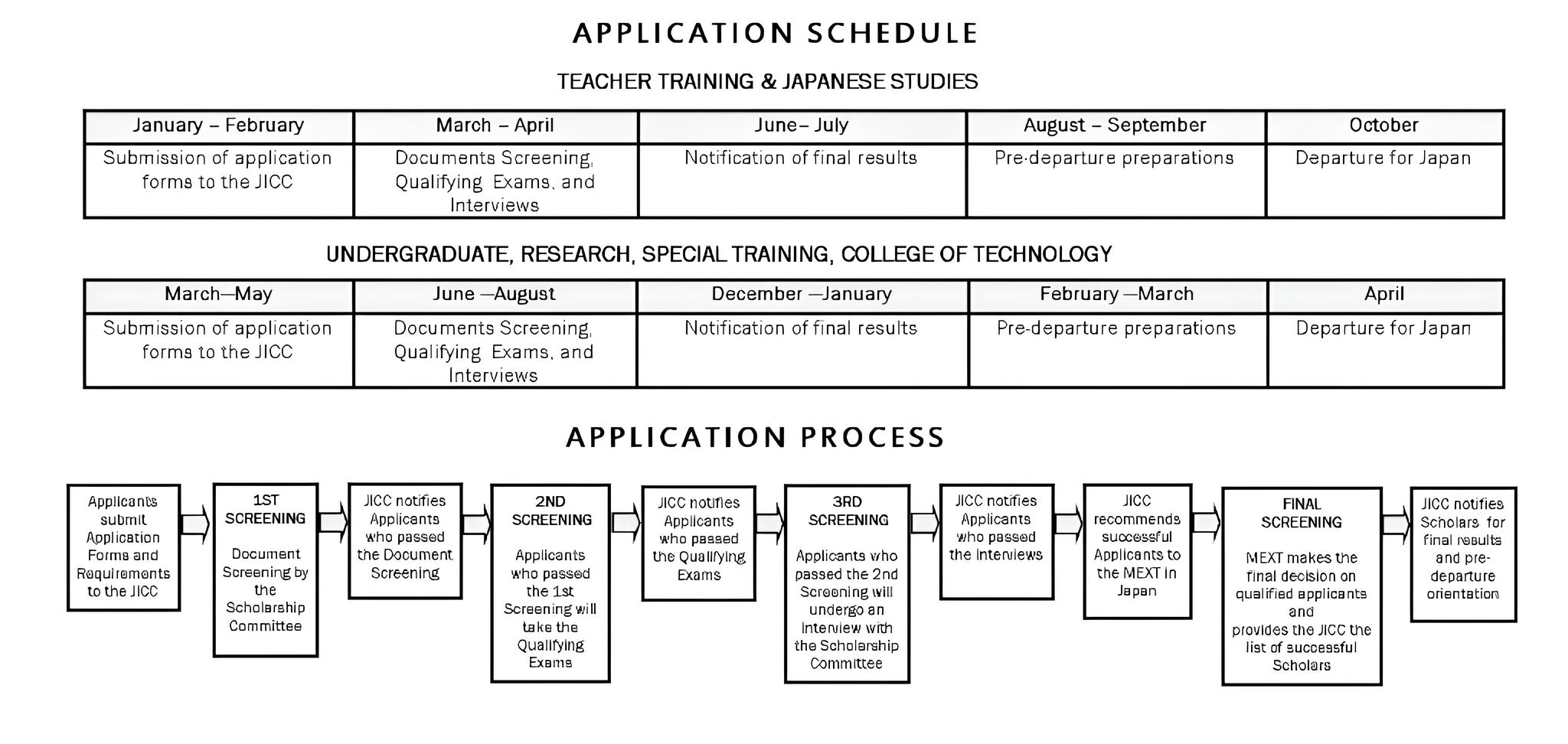
What is the timeline for the Embassy Recommended Scholarship?
March–May Submit your application to the Philippine Embassy. I applied between March and May 2014. For reference, the 2026 deadline (for 2027 intake) is May 29, 2026 — verify the current deadline on the embassy website each year.
June Sit a written English exam in person at the Embassy (approximately 50 questions; expect it to be challenging).
July Attend a panel interview in person. My panel included four Filipino panelists and three overseeing Japanese diplomats. Panelists came from high-level government agencies such as DepEd and DOST. The interview lasted about 15 to 20 minutes.
The goal of the interview is to demonstrate the feasibility and significance of your proposed research in Japan. The panelists will likely not be experts in your field, so avoid getting lost in technical details. Instead, present the big picture clearly. They are assessing your confidence, maturity, drive, and ability to communicate. Many successful applicants are in their mid-20s to early 30s, as they have had time to build a track record — but strong younger applicants are also accepted.
August You receive an official certificate confirming that you have passed the second screening. You must then immediately begin seeking a research placement by contacting prospective professors and universities, with a deadline of end of September.
January (the following year) The official MEXT scholarship award is given to applicants who have secured a tentative research placement with a professor at a Japanese university or institute.
February–March Apply for your visa and book your flight.
March Attend the pre-departure orientation. When I went through this, there were about 23 of us — selected from approximately 160 applicants.
April Depart for Japan.
After Arriving in Japan
What should I do if I want to continue to a master’s degree?
Each year around December, your university or research institute will ask you to submit an application for scholarship extension if you plan to enroll in a master’s or PhD program the following academic year (which begins in April or October).
As a research student, you are required to gain admission to a Japanese degree program within 24 months of the start of your research studentship. Application deadlines vary widely — some programs require you to apply as early as three months to a full year before the intake date, so plan accordingly.
My experience: I arrived in Japan in April 2015. I applied to Sokendai’s Department of Astronomical Science for October 2015 admission (application period: July–August). I did not pass the entrance exam — it was extremely difficult. I then applied to The University of Tokyo (application period: October 1–31, 2015). The interview was held on December 1, and results were announced on December 15 — coinciding with the MEXT scholarship extension deadline. I passed, and I had my graduate school for my master’s studies.
How difficult is it to gain admission to a master’s program in Japan?
It depends heavily on the department. In Astronomy, I had to study advanced physics and mathematics. I reviewed past entrance exams and could not solve many of the problems even with the help of online resources. This is the reality for highly competitive institutions like Sokendai and the University of Tokyo.
That said, some friends were required only to submit documents, with no interview or written exam. If that is your situation, consider yourself fortunate. If not: ganbatte kudasai — do your best!
Note that some departments with international programs also require standardized tests such as TOEFL or the GRE, so factor in preparation time for those as well.
What is the MEXT scholarship extension application?
The extension application covers your scholarship funding for the duration of your master’s or PhD program. In the form, you list at most two universities you intend to attend.
Since university application periods vary widely, the best position to be in is one where you have already applied to — and ideally received admission from — at least one of the two universities you list before submitting the extension form. This significantly strengthens your case for receiving the extension.
Can I see sample documents for the scholarship extension application?
(Coming soon — email me if you need them sooner.)
How many universities can I apply to?
There is no limit on the number of universities you may apply to. However, you may only proceed to one of the two universities listed on your MEXT scholarship extension form.
For this reason, it is to your advantage to apply to multiple universities early and to know your results before the extension deadline — giving you a clear picture of your options when you submit the form.
An important cultural note: Japanese academic culture places high value on loyalty to one’s supervisor. Applying to other universities or professors without your current adviser’s knowledge can be seen as disrespectful. Be thoughtful about how you handle this, and err on the side of transparency.
What happens if I do not pass any entrance exams?
You can still submit an application for scholarship extension even without a confirmed admission offer. This is why it is wise to apply to several universities early — so that by the time you submit the extension form, you have a realistic sense of where you are most likely to be accepted.
In my own case, had I continued to be unsuccessful in entrance exams, my scholarship would have ended in March 2017. Even so, the experience and time spent in Japan would not have been wasted.
Did you enjoy your time in Japan?
Mochiron! — Of course! Get in touch if you would like to hear more. Knowing someone is interested is all the motivation I need to write about it.
Have a question not covered here? Send me a message.